

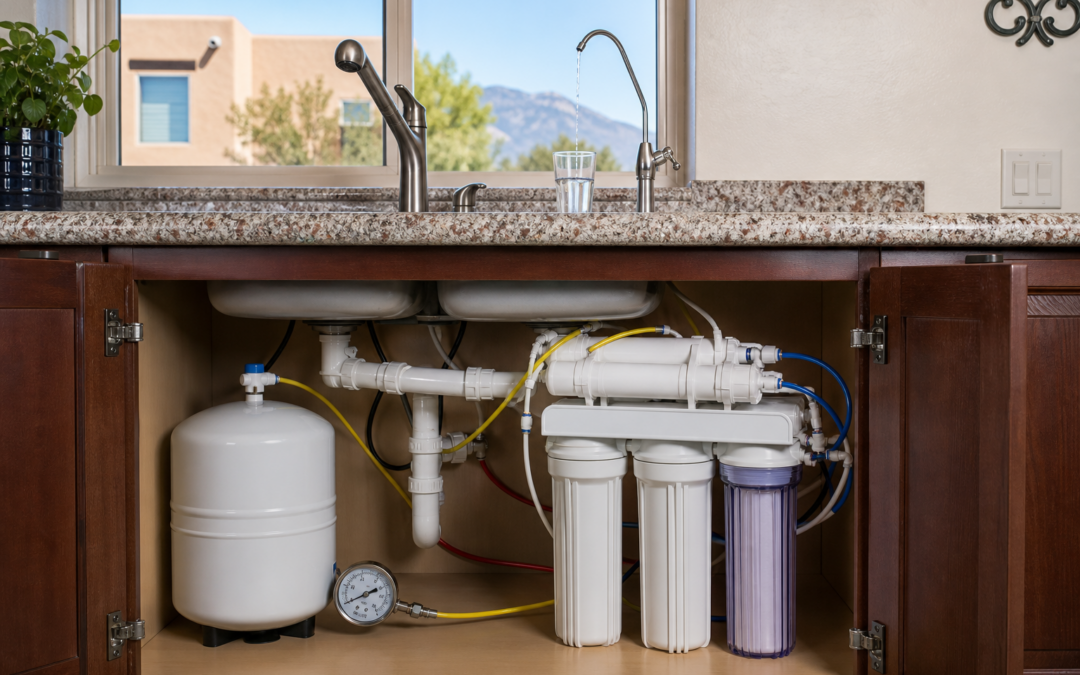
A reverse-osmosis system makes purified water gradually and stores it for use at the dedicated faucet. If the storage tank was just emptied, the stream may weaken until the system has time to produce more water. If a formerly strong stream now stays weak after the tank has had time to refill, the cause may involve incoming pressure, tank reserve, a restricted filter or membrane, tubing, a valve, or the faucet itself.
Start by comparing the dedicated RO faucet with the home’s regular fixtures. Normal flow elsewhere points toward the RO equipment or its small delivery line. Weak flow throughout the home is a different problem and should not be diagnosed from the RO system alone. Avoid opening filter housings or adjusting the pressurized storage tank; useful measurements can be made during a service visit without guessing at a component.
First Decide Whether the Storage Tank Was Recently Emptied
An under-sink RO membrane does not usually make water as quickly as a kitchen faucet can deliver it. The system sends treated water into a storage tank, and the tank supplies the useful stream when the dedicated faucet opens. Filling several containers, using a large amount of drinking water, or draining the tank during maintenance can temporarily use that reserve faster than the membrane replaces it.
Close the dedicated faucet and allow the system to refill without drawing more RO water. The required time depends on the equipment, incoming pressure, water temperature, membrane condition, tank capacity, and recent use, so a universal wait time would be misleading. If the stream returns after the tank replenishes, the immediate symptom may have been an exhausted reserve rather than a failed part.
A tank that repeatedly provides only a small amount of useful water, loses its initial stream very quickly, or never seems to recover deserves inspection. Do not add air or release pressure from the tank as a test. Tank charge must be evaluated under the correct empty or isolated condition with equipment-specific measurements.
Compare the RO Faucet With Other Fixtures
Turn on a normal cold-water faucet elsewhere in the home and note whether its flow seems typical. This simple comparison does not measure pressure, but it helps define the boundary of the symptom.
- If regular fixtures are normal and only the dedicated drinking-water faucet is slow, the restriction is likely within the RO supply, storage, delivery tubing, or faucet path.
- If several fixtures have become weak, the home may have a broader supply or pressure condition that needs separate plumbing evaluation.
- If the RO faucet alternates between a brief stronger stream and a trickle, record how long the stronger flow lasts and whether it changes after refill time.
- If the symptom began immediately after service, cabinet work, or moving stored items, look for an accessible tube or valve that may have been disturbed.
The Micromax 7000 reverse-osmosis system illustrates the membrane, filtration, and storage arrangement used to prepare drinking water. Normal membrane production is intentionally gradual. That does not mean a newly weak delivered stream should be accepted without checking the stored-water and delivery path.
Storage-Tank Reserve Affects the Useful Stream
The RO storage tank contains water on one side of a flexible internal barrier and a controlled air charge on the other. That air charge helps push stored water toward the faucet. Too little useful reserve, an incorrect charge, a damaged internal barrier, or a tank valve problem can change how much water reaches the glass and how quickly the stream fades.
The location of the tank or the way it feels from the outside cannot confirm which condition exists. A heavy tank may contain water but still deliver poorly. A light tank may simply be depleted. Tapping the tank, shaking it, or judging it by sound is not a reliable diagnosis.
Leave the tank connected and pressurized. A technician can isolate and empty it correctly, measure the air charge under the specified condition, confirm the valve position, and compare stored volume with delivered flow. Adjusting the tank while it contains water can produce a false reading and create a new problem.
Restricted Filters or Membrane Performance Can Reduce Production
RO systems use prefilters to protect the membrane and may use a postfilter before the drinking-water faucet. As these components collect material, water can move through them less easily. A restricted prefilter can reduce the pressure available to the membrane. A restricted postfilter can limit delivery from the tank. A membrane that no longer performs as intended can also change production.
Service intervals vary with local water conditions, household use, equipment design, and the installed components. A calendar date alone does not prove that a filter is clogged, and replacing every component at once can hide the actual cause. Note the last known service date and any change in taste, sound, or production, but keep the diagnosis focused on measured flow and pressure.
Do not remove a housing to inspect a cartridge while the system is connected to the water supply. Filter housings can retain pressure, and an incorrect seal or seating problem can create a leak. The stages of reverse-osmosis filtration provide useful component context, while a service check determines which stage is actually restricting the system.
Incoming Pressure Matters to RO Production
The membrane needs adequate incoming pressure to move water through its treatment path. When feed pressure falls, the system may refill the tank more slowly and produce less useful water between draws. The cause can be outside the RO unit, at an accessible supply valve, or within a prefilter or feed connection.
Confirm only what can be observed safely. Check whether the RO supply valve is visibly in the same fully open position it normally uses, but do not force a stiff or unfamiliar valve. Look for a flexible tube pinched behind the storage tank, sharply bent around a cabinet item, or compressed by a drawer. Move loose household items away from the tubing without pulling on fittings.
Some systems use a booster pump when feed pressure requires it. A pump, pressure switch, or electrical control should be tested according to the installed design. Do not add a pump or change pressure settings based only on a slow faucet. MicroPure’s Albuquerque reverse-osmosis overview explains why pressure and installation conditions matter to system operation.
The Delivery Tube, Valve, or Faucet May Be the Restriction
Water leaving the storage tank still has to pass through a small delivery tube, one or more valves, and the dedicated faucet. A partly closed tank valve, kinked tube, displaced cabinet item, or restriction at the faucet can reduce the final stream even when the membrane is producing water.
Inspect the visible route with a flashlight. Look for a tight bend, flattened section, damp fitting, or tube pulled against a sharp cabinet edge. Confirm that stored products are not pressing on the line or tank valve. If a labeled handle has an obvious normal position, photograph it for the technician rather than repeatedly operating it.
Do not disconnect push fittings, cut tubing, insert a wire into the faucet, or use chemicals to clear the outlet. A small obstruction can be located after the system is isolated, and the correct repair must preserve sanitary drinking-water connections.
Safe Observations Make Service Faster
Useful notes can narrow the diagnosis without dismantling anything:
- When the slow flow began and whether it changed suddenly or gradually.
- Whether the dedicated faucet starts stronger and then fades.
- Whether the tank had been drained or a large amount of RO water was just used.
- Whether normal household fixtures still have their usual flow.
- Whether the system recently received filters, a membrane, cabinet work, or plumbing service.
- Whether any visible RO tube is kinked, flattened, wet, or pressed by stored items.
- Whether the system runs continuously, makes a new sound, or stops producing water entirely.
- How much water the faucet delivers over a timed interval, using a clean container without altering the equipment.
Stop the observation if water is leaking, a fitting moves, an electrical component is wet, or the system behaves unexpectedly. Use a clearly identified RO supply shutoff only when it is safe and familiar. If the correct valve is uncertain, leave it alone and request service.
Avoid removing filter housings, changing the membrane, adjusting tank pressure, bypassing treatment stages, forcing valves, disconnecting tubing, or repeating drain-and-refill tests. Those actions can erase useful evidence or add a leak to the original flow problem.
What a Reverse-Osmosis Service Visit Checks
A technician can test the system as a connected treatment and delivery path rather than guessing from the faucet alone. The evaluation may include:
- Incoming feed pressure under the conditions the RO system actually sees.
- Pressure before and after relevant filters to identify a restriction.
- Storage-tank water reserve and air charge under the correct isolated condition.
- Membrane production and performance using the equipment’s specifications.
- Tank, supply, and delivery valve position and operation.
- Tubing route, fittings, check valves, shutoff controls, and faucet flow.
- Evidence of a leak or continuous drain condition that reduces stored water.
- Final delivered flow after the confirmed maintenance or repair.
The findings should separate a normal refill condition from a component that needs maintenance, adjustment, or replacement. After the work, the tank should be allowed to refill and the dedicated faucet should be checked under the same conditions that produced the complaint.
Maintenance or Repair Depends on the Confirmed Cause
A restricted service item may call for scheduled maintenance. A kinked tube or partly closed valve may need a narrow correction. A tank that cannot hold or deliver its intended reserve, a damaged faucet, a control problem, or membrane performance outside the expected range can lead to a different repair.
Age alone does not decide the outcome. Parts availability, water conditions, prior service, installation quality, and the condition of the complete system matter. Ask which measurement identified the restriction and how the proposed work will restore both production and delivery. Replacing unrelated components without a confirmed reason can add cost without resolving the slow stream.
Request Reverse-Osmosis Service in Albuquerque
If the dedicated faucet remains slow after the storage tank has had a reasonable opportunity to refill, preserve the observations rather than opening the system. Note whether other fixtures are normal, whether the first stream fades quickly, and whether any accessible tubing looks compressed.
Contact MicroPure Water Systems to have the feed pressure, tank reserve, filters, membrane, tubing, valves, and faucet checked as one system. A measured diagnosis can identify whether the RO unit needs routine service or a specific repair and confirm the delivered flow before it returns to use.